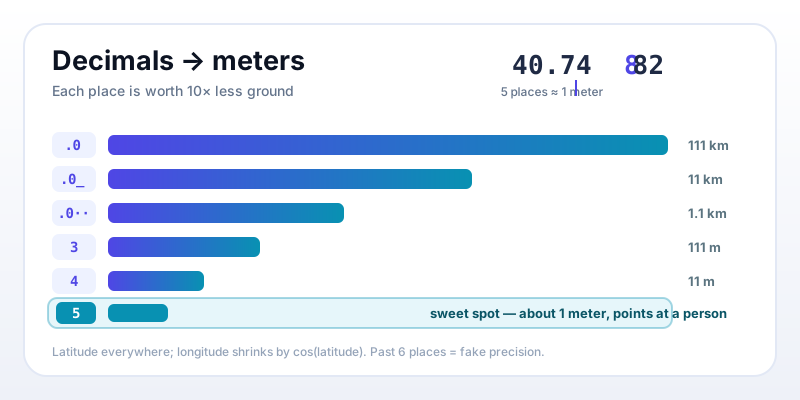
A GPS coordinate like 40.748817 has six decimal places. Your phone might hand you twelve. A surveyor needs eight; a hiker needs five; a country needs one. The number of digits you keep after the decimal point is not cosmetic — each place is worth a specific distance on the ground, and keeping more than your data actually resolves is a quiet form of lying. This is the cheat sheet for how much precision to report and why.
The decimal-places-to-meters table
One degree of latitude is about 111 kilometers everywhere on Earth. Every decimal place you add divides that distance by ten. That single fact gives you the whole table — and it is the most-screenshotted reference in all of coordinate work for good reason. The distances below are for latitude (and for longitude at the equator); the longitude caveat comes a few sections down.
| Decimal places | Degrees | Distance (equator) | What it resolves |
|---|---|---|---|
| 0 | 1.0° | ~111 km | A country or large region |
| 1 | 0.1° | ~11.1 km | A large city |
| 2 | 0.01° | ~1.11 km | A town or neighborhood |
| 3 | 0.001° | ~111 m | A village or city block |
| 4 | 0.0001° | ~11.1 m | A building or large tree |
| 5 | 0.00001° | ~1.11 m | A doorway, a person |
| 6 | 0.000001° | ~0.111 m (11 cm) | Survey-grade detail |
| 7 | 0.0000001° | ~0.011 m (1.1 cm) | Beyond consumer GPS |
Read it like a ruler. The fourth decimal puts you on the right building. The fifth puts you on the right side of the doorway. The sixth and seventh describe distances smaller than the error of the device that produced the coordinate, which is the heart of the problem we will get to.
Why each place is worth 10×
The math is just place value. Latitude runs from the equator to a pole — that quarter-circle is about 10,000 km by the original definition of the meter, which works out to roughly 111 km per degree. Because decimal notation is base ten, moving one digit to the right of the decimal point shrinks its value by a factor of ten:
- 0.1° is one tenth of 111 km = 11.1 km
- 0.01° is one hundredth = 1.11 km
- 0.001° is one thousandth = 111 m, and so on down the column.
So you never need to memorize the table — you only need the anchor (1° ≈ 111 km) and the knowledge that each new decimal divides by ten. If someone hands you 0.00001° and asks "how far is that," start at 111 km and shift the decimal five places left: 1.11 m.
The five-decimal sweet spot
For almost everything a phone or handheld GPS does, five decimal places is the sweet spot, resolving to about one meter. That is not an arbitrary preference; it is matched to reality on both ends:
- It matches what the hardware can deliver. A good consumer GPS receiver under open sky is accurate to a few meters at best. Reporting to one meter (five places) already meets or slightly exceeds the real resolution of the fix.
- It matches what humans need. One meter is enough to mark a trailhead, a campsite, the corner of a building, or a "meet me here" pin. You are pointing at a person, not a screw.
- It stays readable. 40.74882, -73.98543 is short enough to read aloud, type, and double-check. Twelve-digit strings invite transcription errors and false confidence.
If you want a single rule to walk away with: five places for anything you hand to a human, six only if a survey instrument earned them. Six places (about 11 cm) belongs to RTK and differential GPS gear, not to a phone. Seven and beyond describe distances finer than the noise in your signal — they are decoration.
How few can you get away with?
Plenty of jobs need less, and trimming is free. Geotagging a photo to "this beach" is fine at three or four places. Plotting which town a data point falls in needs two. A choropleth map colored by region is happy at one. Match the digits to the question: if the answer is "which neighborhood," carrying six places is wasted ink and a maintenance liability when someone later assumes that precision is real.
The longitude caveat: cosine of latitude
Here is the catch the famous table hides. Those distances are exact for latitude everywhere, but for longitude they only hold at the equator. Lines of longitude (meridians) all meet at the poles, so they crowd closer together the farther you go from the equator. The ground distance of one degree of longitude shrinks by the cosine of your latitude:
longitude distance = (equator distance) × cos(latitude)
Cosine is 1 at the equator (no shrinkage) and 0 at the poles (meridians touch). So one decimal place of longitude is worth less ground the higher your latitude:
| Latitude | cos(lat) | 0.00001° longitude (5 places) |
|---|---|---|
| 0° (equator) | 1.00 | ~1.11 m |
| 30° | 0.87 | ~0.96 m |
| 45° | 0.71 | ~0.79 m |
| 60° | 0.50 | ~0.56 m |
| 70° | 0.34 | ~0.38 m |
The practical upshot is reassuring: longitude only ever gets more precise per decimal as you move toward the poles, never less. So if five places gives you one-meter resolution at the equator, it gives you better-than-one-meter longitude resolution everywhere else. You will never under-resolve by trusting the table for longitude — you will only ever have a little precision to spare. The cosine matters most when you are computing distances or grid spacing yourself, not when you are deciding how many digits to keep.
Fake precision: the digits that lie
A phone happily reports 40.7488170233, but the last several digits are pure fiction. The receiver's actual fix might be good to three or four meters; everything past the fifth decimal is the math library padding the number, not the satellites resolving your position. Carrying those digits creates false precision — a coordinate that looks ten times more certain than it is.
Why it matters beyond tidiness:
- It misleads the next reader. Eight decimal places implies millimeter knowledge. Anyone downstream may treat the point as exact and build on sand.
- It hides the real error. The honest way to report a position is value plus uncertainty (e.g. ±4 m). When you can't carry an error bar, the digit count is your implied error bar — so make it tell the truth.
- It bloats data. Across a million rows, trailing junk digits are storage and bandwidth spent encoding noise.
The rule of thumb: never report more precision than your measurement supports. If your fix is good to a few meters, five decimals is the most you should keep, and rounding to five is the right move — it is not "losing data," because there was no data there to begin with. When you want to know how accurate your fix actually is before deciding where to round, run the GPS accuracy test and let the reported uncertainty pick your decimal count for you.
Round at the end, not in the middle
If you do calculations (distances, midpoints, conversions) keep full precision through the math and round only the final value you display. Rounding inputs early lets small errors compound. The table tells you where to round for output; the arithmetic in between should stay long.
A worked example: trimming a coordinate
Say your phone gives you 40.7488170233, -73.9854280112 for a spot in Manhattan. You want to share it with a friend who is meeting you there. Walk down the table:
- Goal: point at a doorway a person can find → about one meter → 5 places.
- Round latitude: 40.7488170233 → 40.74882 (the sixth digit, 7, rounds the fifth up from 1 to 2).
- Round longitude: -73.9854280112 → -73.98543.
- Result: 40.74882, -73.98543 — readable and accurate to roughly the width of a doorway.
The discarded digits (170233 → 2, and so on) described positions far finer than the phone could ever know. You lost nothing real and gained a coordinate a human can actually use.
Quick reference: how many places do I need?
- 1 place — which region or large city.
- 2 places — which town or neighborhood.
- 3 places — which block or village (~100 m).
- 4 places — which building (~11 m).
- 5 places — the everyday sweet spot, ~1 m, points at a person.
- 6 places — survey-grade (~11 cm); only if your instrument earned it.
- 7+ places — fake precision for consumer GPS; round it off.
Put the right number of digits to work
The whole cheat sheet collapses to one habit: keep five decimal places for anything a person will use, fewer when the question is coarser, and treat anything past six as noise unless a survey instrument produced it. That keeps your coordinates truthful about how much they really know.
To see your own position at a sensible precision, open what are my coordinates for a clean live readout, or drop a pin to grab any spot on the map. To check how many meters your current fix is good for before you round, the GPS accuracy test shows it directly. For the same point reformatted into DMS, UTM, MGRS, or a Plus Code, the coordinate converter handles every format at once. For the format mechanics, see converting decimal degrees to DMS and the broader guide to GPS accuracy.