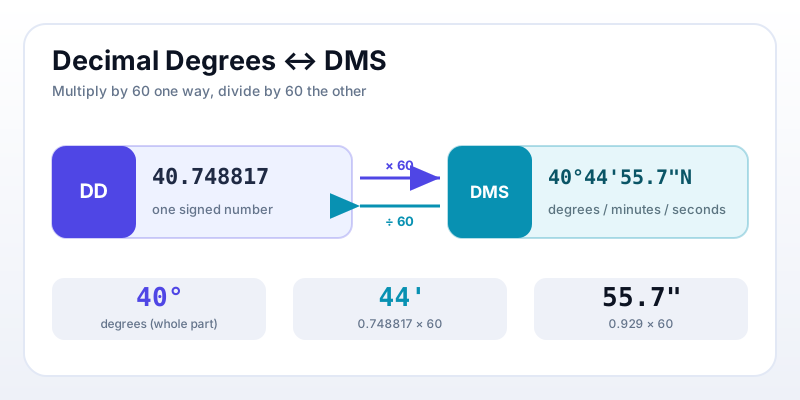
Your phone gives you coordinates like 40.748817, -73.985428. Your handheld GPS, your nautical chart, and half the forms online want 40°44'55.7"N, 73°59'07.5"W instead. Same point on Earth, two ways of writing it. Here's the exact arithmetic in both directions — decimal degrees to degrees-minutes-seconds and back — with two worked examples and a sign-to-direction table.
The two formats, in one minute
Decimal degrees (DD) writes a coordinate as a single signed number per axis: a latitude and a longitude, each with a decimal fraction. A positive latitude is north, negative is south; positive longitude is east, negative is west. It is the format apps, spreadsheets, and APIs prefer because it is just a number you can do math on.
Degrees, minutes, seconds (DMS) splits each value into three parts, borrowing the same idea as a clock face. One degree contains 60 minutes, and one minute contains 60 seconds. So a value like 40°44'55.7" reads as "40 whole degrees, plus 44 sixtieths of a degree, plus 55.7 thirty-six-hundredths of a degree." Instead of a minus sign, DMS uses a compass letter — N, S, E, or W — to carry the direction.
Because both describe the same position, converting between them is pure arithmetic. No projection, no lookup table, just multiplying or dividing by 60.
Decimal degrees to DMS: multiply by 60
Going from a single decimal number to three parts is a "split off the whole, scale up the leftover" routine. Do it once per axis (once for latitude, once for longitude). Work with the absolute value — drop the minus sign for now — and reattach direction at the end.
- Degrees = the whole-number part of your value. Everything to the left of the decimal point.
- Minutes = take the leftover decimal fraction, multiply by 60, and keep the whole-number part of that result.
- Seconds = take whatever fraction is still left over after the minutes step, multiply by 60 again, and that is your seconds (decimals allowed).
- Direction = the compass letter from the original sign and axis (see the table below).
Worked example: 40.748817 latitude
This is the latitude of a well-known building in midtown Manhattan. It is positive, so it will end in N.
- Degrees: the whole part is 40. Leftover fraction: 0.748817.
- Minutes: 0.748817 × 60 = 44.92902. The whole part is 44 minutes. Leftover fraction: 0.92902.
- Seconds: 0.92902 × 60 = 55.74 seconds (rounded to two places).
- Direction: positive latitude → N.
Result: 40°44'55.7"N. Notice how each step hands its leftover to the next: the degrees step passes 0.748817 to minutes, and the minutes step passes 0.92902 to seconds. That hand-off is the whole trick.
Worked example: -73.985428 longitude
Same point's longitude. It is negative, and longitude negatives are west, so this one ends in W. Work with 73.985428 and forget the sign until the end.
- Degrees: whole part is 73. Leftover: 0.985428.
- Minutes: 0.985428 × 60 = 59.12568. Whole part is 59 minutes. Leftover: 0.12568.
- Seconds: 0.12568 × 60 = 7.54 seconds.
- Direction: negative longitude → W.
Result: 73°59'07.5"W. Put the two together and 40.748817, -73.985428 becomes 40°44'55.7"N, 73°59'07.5"W — the same spot, dressed for a chart.
DMS to decimal degrees: divide by 60
The reverse direction is even simpler because there is no splitting to do — you are collapsing three parts back into one number. The rule: DD = degrees + (minutes / 60) + (seconds / 3600). Seconds divide by 3600 because there are 60 minutes in a degree and 60 seconds in a minute, and 60 × 60 = 3600.
- Take the degrees as they are.
- Divide the minutes by 60.
- Divide the seconds by 3600.
- Add the three together.
- Apply the sign: if the direction letter is S or W, make the result negative. N and E stay positive.
Worked example: 51°28'40.1"N
This is the latitude of the Royal Observatory at Greenwich. The letter is N, so the answer stays positive.
- Degrees: 51.
- Minutes: 28 / 60 = 0.466667.
- Seconds: 40.1 / 3600 = 0.011139.
- Add: 51 + 0.466667 + 0.011139 = 51.477806.
- Sign: N → positive.
Result: 51.477806. If that same coordinate had been written 51°28'40.1"S, every step would be identical except the final answer would be -51.477806.
Signs and compass letters: the mapping table
The single most common conversion mistake is getting the direction wrong — putting a southern point in the northern hemisphere, or flipping east and west. The fix is to memorize one small rule: positive is up-and-right (North and East), negative is down-and-left (South and West). Here is the full mapping for both axes.
| Axis | Sign in DD | Compass letter in DMS |
|---|---|---|
| Latitude | Positive (e.g. 40.74) | N (North) |
| Latitude | Negative (e.g. -33.86) | S (South) |
| Longitude | Positive (e.g. 2.35) | E (East) |
| Longitude | Negative (e.g. -73.98) | W (West) |
Two quick sanity checks that catch almost every flip. First, latitude only ever runs from -90 to +90, while longitude runs from -180 to +180 — if your "latitude" is 120-something, you swapped the two numbers. Second, the first letter of a DMS pair is always N or S (latitude), and the second is always E or W (longitude). If you see two N/S letters, something is wrong.
Rounding, leading zeros, and other gotchas
The arithmetic is exact, but how you write the result trips people up. A few rules keep your coordinates clean and unambiguous.
- Don't round too early. If you round the minutes to a whole number before computing seconds, the error cascades. Carry the full decimal through each step and only round the final seconds value.
- Mind your precision. One second of latitude is roughly 31 meters on the ground, and one decimal place of a second is about 3 meters. Round seconds to one or two decimals for navigation; you rarely need more. In decimal degrees, the fifth decimal place is about a meter, so 40.74882 is plenty for everyday use.
- Use leading zeros for readability. Charts conventionally pad to two digits: write 07.5" not 7.5", and 59' not just 59 in a hurry. It keeps columns aligned and avoids "is that 7 or 70?" confusion.
- Watch the symbols. Degrees use °, minutes use a single prime ' and seconds a double prime ". A lot of data uses a plain apostrophe and straight quote instead, which is fine, but never mix a comma in where a decimal point belongs.
- 59.999 is not a degree. If a result comes out as 44'60", you rounded up past the wrap point — bump the next unit up instead (that becomes 45'00").
When you should just let a tool do it
Doing the math by hand is worth understanding once — it demystifies what the numbers mean and lets you sanity-check a suspicious coordinate. But for day-to-day work, typing into a converter is faster and removes the rounding and sign errors entirely. Our coordinate converter takes a position in DD or DMS and shows it in every format at once, including UTM and Plus Codes, so you can paste in whatever your gear gave you and read out whatever the next form wants.
If you don't have a starting coordinate yet, grab your current position with the what-are-my-coordinates tool, or pick any spot on the map with drop a pin — both give you a clean DD reading you can run through the steps above. And if you want the bigger picture of how DD, DMS, UTM, MGRS, and Plus Codes all relate, the coordinate formats guide lays them side by side.
The takeaway: decimal degrees to DMS is multiply-by-60, twice; DMS to decimal degrees is divide-by-60-and-3600, then add. Keep the sign-to-letter table in mind, don't round until the end, and you can translate any coordinate by hand. When speed matters, hand it to the coordinate converter.