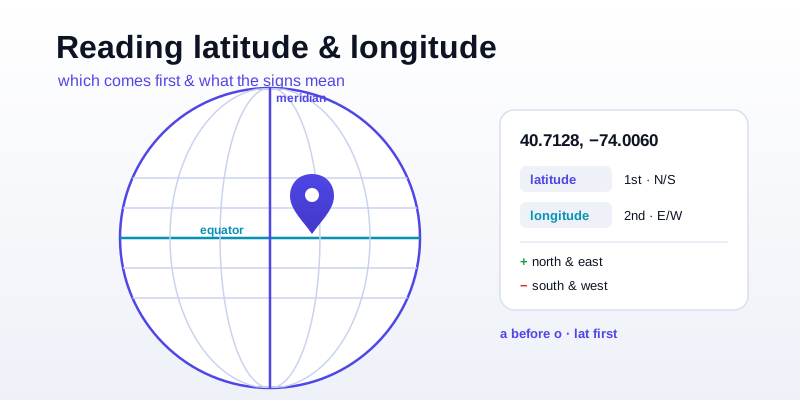
Sooner or later someone hands you a pair of numbers — 40.7128, -74.0060 — and expects you to do something with them. Drop a pin, meet a friend, mark a trailhead. But which number is which? Which comes first, and what is that minus sign doing there? Here's how to read latitude and longitude correctly, so you never end up in the wrong hemisphere by accident.
Latitude and longitude in one minute
Every point on Earth is described by two numbers. Latitude tells you how far north or south you are — your distance from the equator. Longitude tells you how far east or west you are — your distance from the Prime Meridian, the line that runs through Greenwich, England.
Picture the globe wrapped in a grid. The horizontal rings stacked from the equator up to the poles are lines of latitude (they stay parallel, which is why they're also called parallels). The vertical lines running pole to pole are lines of longitude (also called meridians). Any place on Earth is just the intersection of one parallel and one meridian — one latitude value and one longitude value. That's the whole system.
Which comes first: latitude or longitude?
The near-universal convention is latitude first, then longitude. When you see a coordinate pair written as two numbers separated by a comma, read the first as your north-south position and the second as your east-west position.
The easiest way to remember the order is alphabetical: "a" comes before "o" — latitude before longitude. It works in the alphabet, and it works on the page. A few more memory hooks if that one doesn't stick:
- Lat is flat. Latitude lines run flat and horizontal, like the rungs of a ladder ("lat-itude" / "ladd-er"). Longitude lines run the long way, top to bottom.
- X marks the comma. In coordinate pairs the order is lat, long — but be warned, this is the opposite of math's (x, y), where x is horizontal. More on that trap below.
- Equator first. You measure off the equator (latitude) before you measure off the meridian (longitude).
So in 40.7128, -74.0060, the 40.7128 is latitude (north of the equator) and the -74.0060 is longitude (west of Greenwich). That's New York City.
What the positive and negative signs mean
The sign in front of each number is not decoration — it's the direction. A coordinate has both a size (how far) and a sign (which way). Here is the complete mapping, and it's worth memorizing because it's the part people get wrong most often:
| Value | Sign | Direction | Letter |
|---|---|---|---|
| Latitude | Positive (+) | North of equator | N |
| Latitude | Negative (−) | South of equator | S |
| Longitude | Positive (+) | East of Greenwich | E |
| Longitude | Negative (−) | West of Greenwich | W |
One short sentence captures it: positive is north and east; negative is south and west. So Sydney, Australia sits at roughly -33.87, 151.21 — negative latitude (south of the equator) and positive longitude (east of Greenwich). Rio de Janeiro is around -22.91, -43.17 — both negative, because it's south and west.
You'll also see the same information written with letters instead of signs. 40.7128° N, 74.0060° W means exactly the same thing as 40.7128, -74.0060. The "N" replaces the plus sign; the "W" replaces the minus. Crucially, when letters are present the numbers are written as positives — the direction letter carries the sign. Mixing the two systems (writing a minus sign and a "W") is a common way to accidentally flip a hemisphere.
Valid ranges: how to spot a number that can't be right
Latitude and longitude each have a fixed range, and knowing them lets you catch bad data at a glance.
- Latitude runs from -90 to +90. Zero is the equator, +90 is the North Pole, -90 is the South Pole. You can't be more than 90 degrees from the equator — there's nowhere further to go.
- Longitude runs from -180 to +180. Zero is the Prime Meridian, and +180 / -180 meet on the opposite side of the planet, near the International Date Line in the Pacific.
This gives you a quick sanity check. If the first number in a pair is bigger than 90 — say 122.4 — it cannot be a latitude. That's a strong sign the pair has been written backwards (longitude first), because longitude is the only one of the two that's allowed past 90. For example, San Francisco is 37.77, -122.42. If you ever see it as -122.42, 37.77, the out-of-range 122 in the first slot is the tell: someone swapped the order.
The wrong-hemisphere bug: swapped order and dropped signs
Two small mistakes cause the overwhelming majority of "the pin is in the ocean" moments. Both are easy to make and easy to catch once you know them.
1. Swapping the order (lat/long reversal)
Because mapping uses lat, long but math and many graphics libraries use (x, y) = (long, lat), it's incredibly common for the two to get switched when data passes between systems. The result lands you somewhere bizarre — often in a different hemisphere entirely, or floating in the sea. The fix: trust the range check. If the first value exceeds 90 (or, for longitude in the second slot, the numbers just feel off for the place you know), try swapping them and see if the location snaps to where it should be.
2. Dropping or flipping a sign
Lose the minus on a longitude and you teleport from the Americas to Asia. Lose it on a latitude and you jump across the equator. A classic case: 40.71, 74.01 (no minus) puts you in western China instead of New York, because 74 east is a completely different place from 74 west. Whenever you copy coordinates by hand, double-check that every negative survived the trip — and remember that "N/E" with no symbol means positive, while "S/W" means the number should be negative if you convert it to signed form.
A 30-second habit prevents both bugs: after entering a pair, glance at the map and ask "is this even the right continent?" Your brain catches a hemisphere flip instantly, even when your eyes skim past a missing minus sign.
Reading the three common formats
The same point can be written three ways, which trips up beginners who think they're looking at different places. They're not — just different notations for the same latitude and longitude:
- Decimal degrees (DD): 40.7128, -74.0060 — one number per axis, signs for direction. This is what most apps, URLs, and databases use.
- Degrees, minutes, seconds (DMS): 40°42'46" N, 74°00'22" W — the traditional format you'll see on paper maps and in aviation. A degree splits into 60 minutes, a minute into 60 seconds.
- Degrees and decimal minutes (DDM): 40°42.768' N, 74°00.360' W — common in marine and GPS use, halfway between the other two.
You don't need to convert these by hand. If you have a reading in one format and need another, the coordinate converter translates between all three (and our deeper guide, coordinate formats explained, walks through why each one exists).
Put it into practice
Reading coordinates comes down to four reliable habits: latitude first (a before o), positive is north and east while negative is south and west, latitude maxes out at 90 and longitude at 180, and a quick glance at the map catches any swap or dropped sign before it matters. Get those four right and you can read any pair of numbers anyone hands you.
Ready to work with your own location? See your exact position in every format with what are my coordinates, place and read any point on a map with drop a pin, or convert a reading you already have using the coordinate converter. Once the order and the signs make sense, every other coordinate task gets easier.