You live across town from a friend, or in the next city over, and you want to meet somewhere fair — a coffee shop that splits the drive, a park halfway between two trailheads. That "meet in the middle" point has a precise definition, and finding it is a quick bit of coordinate math. Here's what a geographic midpoint actually is, why averaging two coordinates is close but not quite right over long distances, and how to turn the answer into a pin you can share.
What "the midpoint" really means
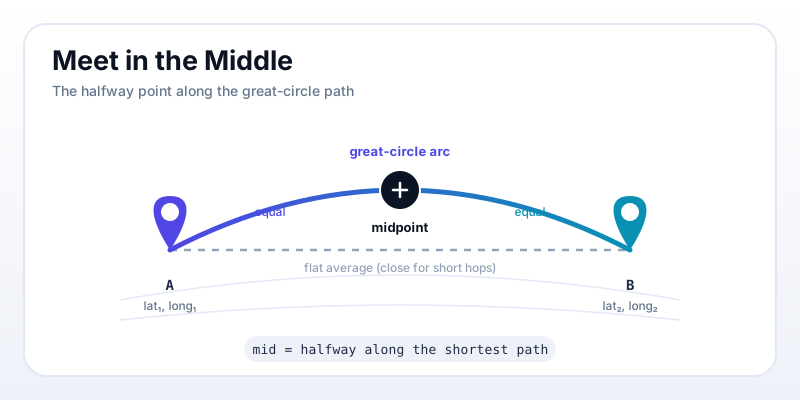
The midpoint between two locations is the point that sits exactly halfway along the shortest path connecting them. On a flat map that path is a straight line, so the midpoint is the obvious middle. On a round planet the "shortest path" is a curve called a great-circle arc — the route an airliner traces — and the midpoint is the point halfway along that curve.
For short, everyday distances the two ideas give the same answer to within a meter or two. Across a country or an ocean they diverge, and the difference is large enough to matter. So there are really two midpoints worth knowing about:
- The simple average: add the two latitudes and halve them, add the two longitudes and halve them. Fast, fine for nearby points, and exactly what most people mean when they say "halfway."
- The true great-circle midpoint: the geometric center of the shortest curved path over the globe. This is what aviation, marine navigation, and mapping software use, and it is the one a good calculator returns.
One important caveat up front: a geographic midpoint is halfway in straight-line (or great-circle) distance. It is not necessarily halfway in travel time. A point exactly between two cities might land in the middle of a lake or a roadless ridge. We will come back to that — it is the single most common surprise when people use a halfway point in real life.
The simple way: average the coordinates
If your two points are reasonably close — same metro area, a day's drive, anything under a few hundred kilometers — averaging the coordinates is accurate enough and you can do it in your head or a spreadsheet.
The rule, working in decimal degrees:
- Midpoint latitude = (latitude₁ + latitude₂) ÷ 2
- Midpoint longitude = (longitude₁ + longitude₂) ÷ 2
Keep your signs straight: south latitudes and west longitudes are negative. If one of your numbers is in degrees-minutes-seconds, convert it to decimal degrees first or the averaging will be meaningless.
Worked example: two points in a city
Say Point A is at 40.7580, -73.9855 (Times Square area, New York) and Point B is at 40.7484, -73.9857 (a few blocks south). Averaging:
- Latitude: (40.7580 + 40.7484) ÷ 2 = 81.5064 ÷ 2 = 40.7532
- Longitude: (-73.9855 + -73.9857) ÷ 2 = -147.9712 ÷ 2 = -73.9856
Midpoint: 40.7532, -73.9856. Over a distance this short the great-circle method would shift that by a fraction of a millimeter, so the simple average is exactly right for any practical purpose. That is the case for the overwhelming majority of "where should we meet" questions.
Where simple averaging goes wrong
Averaging treats the world as a flat grid, and the grid lies in two ways once distances grow.
The longitude problem. Lines of longitude squeeze together as you move away from the equator. One degree of longitude is about 111 km at the equator but only about 78 km at 45° latitude and shrinks to nothing at the poles. Averaging longitude as if every degree were the same width nudges the midpoint sideways.
The curvature problem. The shortest path between two far-apart points bows toward the nearest pole. The classic example is a flight from New York to Madrid: both cities sit near 40°N, so the simple average puts the midpoint at 40°N out in the mid-Atlantic. The true great-circle midpoint is meaningfully north of that line, because the real flight path arcs up toward Greenland. Across thousands of kilometers the gap between the two answers can be tens of kilometers.
The table below shows roughly how the discrepancy grows. Treat these as illustrative magnitudes, not survey figures — the exact gap depends on the bearing between your points.
| Separation between A and B | Typical gap: average vs. great-circle midpoint | Does it matter? |
|---|---|---|
| Across a city (under ~25 km) | Under a meter | No |
| Neighboring cities (~100 km) | A handful of meters | Rarely |
| Across a region (~500 km) | Tens to hundreds of meters | Sometimes |
| Across a continent (2,000 km+) | Several to tens of kilometers | Yes |
The practical takeaway: for meeting a friend, average away. For anything spanning a continent or an ocean — or any time you want the answer to be genuinely correct rather than close — use the great-circle midpoint.
The accurate way: the great-circle midpoint
The true midpoint is found with spherical trigonometry. You do not need to memorize the formula, but seeing it demystifies what a calculator is doing under the hood. Convert all four values (the two latitudes and two longitudes) to radians, then compute the difference in longitude and work through these steps:
- Bx = cos(lat₂) × cos(Δlong)
- By = cos(lat₂) × sin(Δlong)
- Midpoint latitude = atan2( sin(lat₁) + sin(lat₂), √((cos(lat₁) + Bx)² + By²) )
- Midpoint longitude = long₁ + atan2( By, cos(lat₁) + Bx )
- Convert the two results back from radians to degrees.
What this is really doing is averaging the two points as 3D vectors on a sphere rather than as numbers on a flat grid, then projecting the average back onto the surface. The atan2 function handles the angle wrap-around (around the ±180° meridian) that trips up naive averaging. For two nearby points the formula collapses to almost exactly the simple average — which is the reassuring proof that the easy method is a valid shortcut for short hops.
This is finicky to do by hand and very easy to get wrong with a stray radian conversion, which is exactly the kind of task to hand to a tool. Our midpoint calculator takes two coordinates and returns the great-circle midpoint directly, so you get the correct answer at any distance without touching a trig function.
From two coordinates to a meeting point: a quick workflow
Here is the end-to-end process, whether you are picking a cafe or planning a rendezvous on a trail.
- Get both coordinates in the same format. Decimal degrees is easiest. If you only know your own spot, read it off with what are my coordinates; for the other location, look it up or have your friend send theirs.
- Compute the midpoint. Average by hand for nearby points, or run both coordinates through the midpoint calculator for a guaranteed-correct great-circle result.
- Sanity-check the distance. Plug the midpoint and either endpoint into the distance between coordinates tool. The midpoint should be the same distance from A as from B — that equality is your built-in error check. If the two distances differ, you swapped a sign or a lat/long pair somewhere.
- Drop a pin and look around. Place the midpoint on a map with drop a pin and see what is actually there. This is the step that catches midpoints that land in a river, on a freeway, or in the middle of a field.
- Adjust for the real world. Nudge the pin to the nearest sensible venue. A geographic midpoint is a starting suggestion, not a mandatory destination.
When the midpoint is not where you should meet
The geographic midpoint answers "what point is equally far from both of us in a straight line." That is often not the same as "where should we actually meet," and knowing the difference saves a wasted trip.
- Roads are not straight lines. If a mountain, a bay, or a one-bridge river sits between you, the equal-distance point may be a 40-minute detour for one person and a 5-minute hop for the other. For fairness by time rather than distance, the midpoint is only a first guess.
- The point may be unreachable. Midpoints happily land in lakes, on private land, or on the wrong side of a fence. Always eyeball it on a map before committing.
- More than two people changes the math. For three or more locations the fair meeting point is the centroid — the average of all the coordinates — not a pairwise midpoint. Averaging every latitude and every longitude across the group gets you a reasonable center; for long distances the same great-circle caveat applies.
- "Halfway" sometimes means time, not distance. If that is your goal, find the geographic midpoint first, then shift toward whichever person has the slower route until the drive times match.
Turning the midpoint into a shareable pin
A pair of coordinates is hard to text and easy to mistype. Once you have the midpoint, make it shareable:
- Drop it on a map with drop a pin, which turns the coordinates into a visible marker and a link you can send.
- Double-check it reads correctly — latitude first, longitude second, with the right signs. A flipped sign can move your "halfway" point to a different continent.
- Send the location, not just the numbers. A shared pin or map link removes any chance your friend pastes the coordinates wrong.
If you want named venues, drive times, or a richer "meet here" experience around that point, a places-and-distance app like places.app can take the midpoint and show what is actually nearby. For meeting up in real time, livelocation.app lets everyone share their live position so you can converge without a dozen "where are you now" texts.
The short version
The midpoint between two locations is the point halfway along the shortest path between them. For nearby points, average the two latitudes and the two longitudes — genuinely correct for any meet-a-friend scenario. For long distances, use the great-circle midpoint so Earth's curvature does not throw your answer off by kilometers. Then verify with an equal-distance check, drop it on a map to confirm it is a real, reachable place, and share it as a pin rather than raw numbers.
Skip the arithmetic and let the midpoint calculator do it: paste in two coordinates, get the exact halfway point, and meet in the middle.