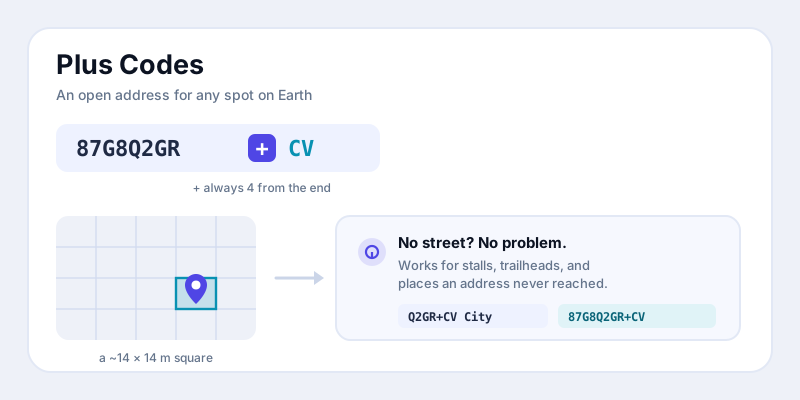
Imagine trying to tell a delivery driver where a market stall sits, or directing a friend to a trailhead that has no street sign, or describing a clinic in a village where the roads were never named. A regular address falls apart in all three cases. Plus Codes were built for exactly these moments: they turn any spot on Earth — building, beach, field, or footbridge — into a short code you can text, speak, or write down. Here is how they work, how to read one, and when a Plus Code beats a street address.
What a Plus Code actually is
A Plus Code (officially the Open Location Code, an open, free standard from Google) is a short string of letters and digits that names a small square on the surface of the planet. It is not tied to any street, city hall, or postal system — it is derived purely from latitude and longitude, so it works everywhere, even in places that have never had an address.
The key idea is simple: instead of two long decimal numbers, a Plus Code packs the same location into about ten characters. A full code points to a square roughly 14 by 14 meters — small enough to land you on the right doorstep, big enough to type without errors. Because it is generated from coordinates, the same code always means the same square, anywhere in the world, forever.
How Plus Codes encode a spot
Under the hood, a Plus Code is a clever shorthand for a pair of coordinates. The world is treated as one giant grid, and the code zooms in step by step:
- The first characters narrow you down to a large region (a block of the globe many kilometers across).
- Each additional pair of characters divides that region into a finer grid, shrinking the target square.
- By the time you reach ten characters, you have homed in on a square about the size of a parking space.
The characters themselves come from a fixed 20-symbol alphabet that deliberately leaves out letters easily confused with numbers (no vowels, so it is hard to accidentally spell a real word or mistype). You never have to decode this by hand — a tool resolves it instantly — but it helps to know the code is just a compressed, human-friendly version of a latitude and longitude.
Reading the format: where the + goes
Every Plus Code has one unmistakable feature: a plus sign that always sits four characters from the end. That separator is your anchor for reading any code.
| Part | Example | Meaning |
|---|---|---|
| Before the + | 87G8P2X7 | The broad area, from continent-scale down to neighborhood |
| The + sign | + | Always four characters from the end — a visual marker, not a math symbol |
| After the + | 9P | The fine detail that pins the exact square |
So a full code like 87G8P2X7+9P reads as one continuous address. Add one more character after the two (for example +9PG) and the square shrinks further, down to roughly 3 meters — useful when you need to mark a single doorway rather than a whole building.
Short codes vs full codes
A full code works on its own anywhere on Earth — it carries enough information to be unambiguous globally. The catch is that the leading characters are the least interesting part: if you already know the rough area, repeating the whole-globe prefix is wasted typing.
That is where a short code comes in. You drop the first four characters and pair what remains with a nearby place name, like this:
- Full code:
87G8P2X7+9P— valid anywhere, no context needed. - Short code:
P2X7+9P New York— shorter and friendlier, but it relies on the town name to know which region you mean.
Short codes are what you will usually see shared in conversation because they are easy to read aloud and remember. Full codes are what you store, embed in a database, or send when you cannot be sure the recipient knows the area. Both resolve to the exact same square; the short version simply borrows context from the place name beside it.
When a Plus Code beats an address
Plus Codes are not meant to replace addresses everywhere — for a house on a named street, the address is still simplest. They shine when a street address is missing, vague, or misleading:
- No address exists. Rural homes, informal settlements, market stalls, campsites, and trailheads often have no postal address at all. A Plus Code gives them one for free.
- The address is ambiguous. A large park, a sprawling campus, or a building with several entrances can share one street address. A Plus Code marks the specific spot you mean.
- You need it to work offline. Once you know a code, it resolves to a place without a live search lookup, which is handy in low-signal areas.
- You want something short to share. A Plus Code is more compact than a full latitude/longitude string and far harder to mis-key than degrees, minutes, and seconds.
For emergencies and meetups, that precision matters. Telling someone "meet me at the third picnic shelter" is fuzzy; a Plus Code puts a 14-meter box exactly where you are standing.
Converting Plus Codes and coordinates
Because a Plus Code is just coordinates in disguise, you can move between the two freely. To generate a code for where you are right now, or to read out your latitude and longitude, start with what are my coordinates. To turn a code you were given back into decimal degrees — or to swap between Plus Codes, DD, DMS, UTM, and MGRS — use the coordinate converter.
If you specifically want to create or decode a Plus Code, the dedicated Plus Code tool does exactly that: paste in a code to see it on a map, or drop a point to get the code back. From there you can copy the short or full version depending on whether you are sharing it in chat or saving it for later.
Once you can spot that + four characters from the end, Plus Codes stop looking like a random jumble: they're a free, open, worldwide address for every place that an ordinary address forgot.